

If you’re reading this, weekly therapy probably isn’t cutting it anymore. Maybe you’ve been going for months and the same worries keep circling back. Maybe you tried to book someone new and got a three-week waitlist. Maybe you’re not even sure “anxiety” is the right word for what you’re feeling — you just know something needs to change.
According to the National Institute of Mental Health, roughly 1 in 5 U.S. adults experiences an anxiety disorder in any given year, and about 1 in 3 will experience one at some point in their life. You are not the outlier here. What’s different is how much it’s affecting your day-to-day — and that’s exactly what determines what kind of help actually fits.
Below are the questions people in Cardiff by the Sea, Encinitas, Solana Beach, and the rest of North County San Diego ask us most often, answered straight.
Quick Answer: Anxiety treatment options range from weekly outpatient therapy to Intensive Outpatient Programs (IOP), Partial Hospitalization Programs (PHP), and residential care, depending on how much daily life is affected. Cognitive Behavioral Therapy (CBT) is the leading evidence-based approach. Most PPO and POS insurance plans offer partial coverage for out-of-network treatment. One Path Mental Health offers in-person anxiety treatment in Cardiff by the Sea, CA, serving North County San Diego.
What Are the Best Anxiety Treatment Options Near Cardiff by the Sea?
There isn’t one “best” treatment — there’s a best fit for where you are right now. Anxiety care generally falls into a few levels, and most people move through them based on how much daily life is being disrupted, not how “bad” their anxiety technically is.
| Level of Care | What It Looks Like | Best For |
|---|---|---|
| Weekly outpatient therapy | 1 session per week, 45–60 minutes | Mild to moderate anxiety that isn’t interfering with work, sleep, or relationships day to day |
| Intensive Outpatient Program (IOP) | Several sessions per week, group + individual work, live at home | Anxiety that’s starting to affect work, school, or relationships, but doesn’t require 24-hour support |
| Partial Hospitalization Program (PHP) | Structured, most days of the week, therapeutic day program | Anxiety significant enough to disrupt daily functioning, often alongside depression or panic symptoms |
| Residential treatment | Live-in, round-the-clock support | Anxiety that has become unmanageable through outpatient care alone |
The honest, expert-backed reality: more anxiety doesn’t automatically mean more treatment — it means the right level of structure for how much it’s currently running your life.
Not sure which column you fall into? That’s exactly what a free initial phone assessment is for. Call (833) 918-7284 and our team will help you figure out the right starting point — no guessing required.
How Quickly Can You Get an Anxiety Therapy Appointment in North County San Diego?
Structured treatment programs typically get you assessed faster than individual private-practice therapy. Waitlists for individual therapists in North County San Diego commonly run anywhere from a few days to several weeks, especially for anxiety and panic specialists. Treatment centers running structured programs — IOP, PHP, and residential — usually move faster, because intake and assessment are built into how the program runs, rather than depending on one clinician’s open calendar slots.
How Much Does Private Anxiety Therapy Cost in California?
Cost depends on three things: the level of care, whether you’re using insurance, and how many sessions per week the treatment involves. As a general shape:
- Weekly individual therapy is typically the lowest per-visit cost, but adds up over months or years of ongoing sessions.
- IOP and PHP cost more per day but are time-limited programs, often weeks rather than years, and are frequently covered in part by PPO and POS insurance plans with out-of-network benefits.
- Most major insurance plans — including Aetna, Cigna, Anthem, BCBS, Humana, and UnitedHealthcare — may cover a significant portion of treatment costs when a plan includes out-of-network mental health benefits.
Clinical guidance from the American Psychological Association is consistent on this point: cost should never be the reason someone delays care, because untreated anxiety tends to become more entrenched, not less, over time.
Don’t want to guess at your own coverage? Verify your insurance in minutes and get a real answer instead of a Google estimate.
Is In-Person Anxiety Treatment Available, or Is It All Virtual?
Telehealth expanded fast over the last several years, and for some people it’s genuinely enough. But anxiety — particularly panic disorder, social anxiety, and cases involving avoidance — often responds better to in-person work, especially anything involving exposure-based techniques, group therapy, or a structured day program where being physically present is part of the treatment itself.
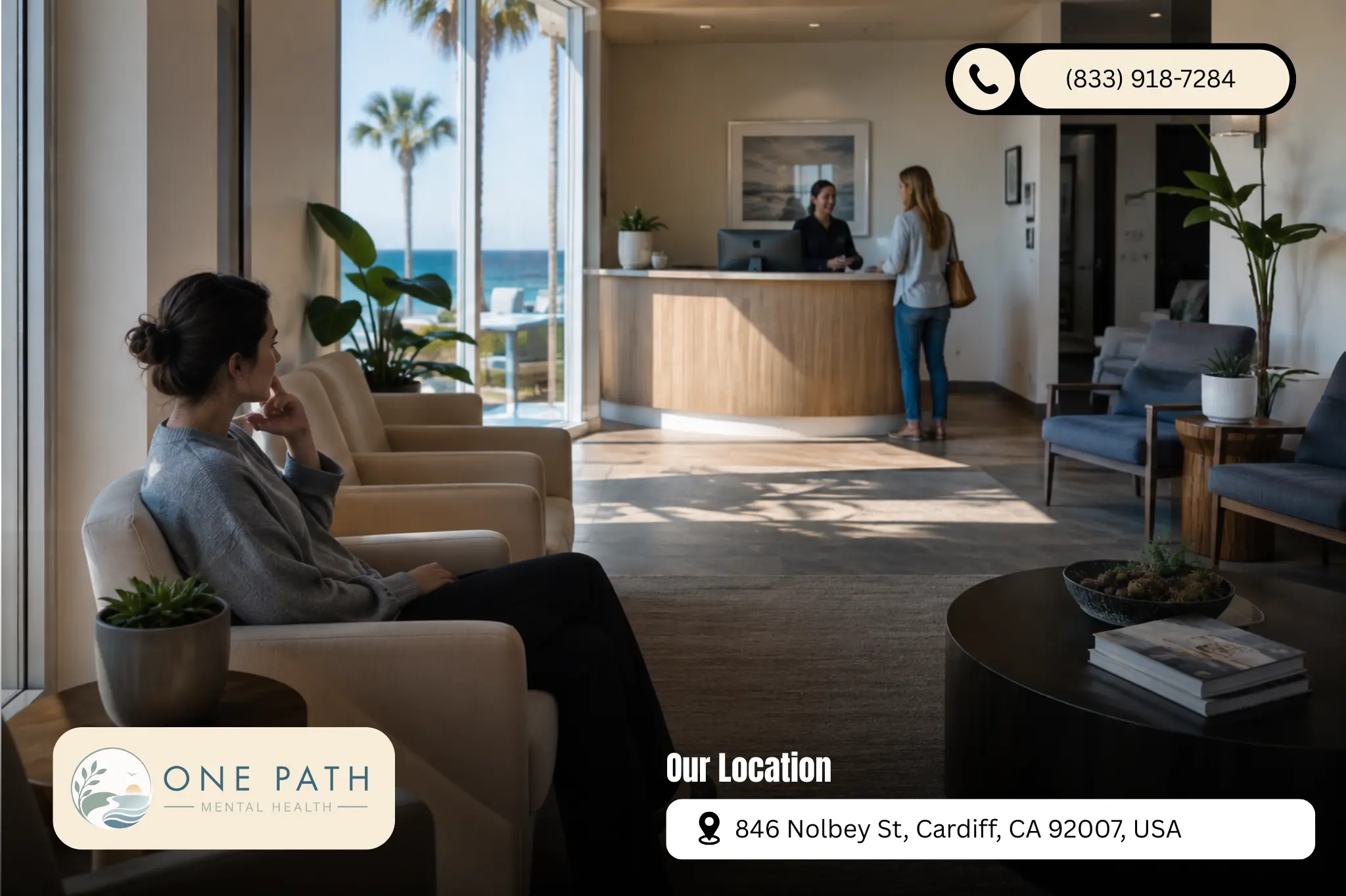
One Path Mental Health offers in-person treatment at our Cardiff by the Sea location, serving clients across North County San Diego including Encinitas, Solana Beach, and Carlsbad, for anyone who wants face-to-face care rather than another video call.
Counselor vs. Therapist vs. Psychiatrist — Who Actually Treats Anxiety?
The short answer: the license behind the title, not the title itself, determines what someone can actually do for your anxiety — including whether they can diagnose it or prescribe medication for it.
| Title | Typical Credential | What They Do for Anxiety |
|---|---|---|
| Counselor | Licensed Professional Counselor (LPC) | Talk therapy, coping strategies, ongoing support |
| Therapist | LMFT, LCSW, or Psychologist (PhD/PsyD) | Talk therapy plus structured modalities like CBT or DBT; LMFTs and LCSWs are also licensed to diagnose |
| Psychiatrist | MD or DO | Diagnosis, medication management, and oversight of complex or co-occurring cases |
In the U.S., “counselor” and “therapist” are frequently used interchangeably in casual conversation, but the license behind the title determines what they’re trained and legally able to do — including whether they can formally diagnose an anxiety disorder or only provide supportive counseling around it. Anyone prescribing medication for anxiety has to be a psychiatrist, psychiatric nurse practitioner, or physician.
How Do You Know If It’s Everyday Stress, or an Anxiety Disorder?
Everyone gets anxious. That’s a normal, useful response to a real threat or deadline. It becomes a disorder when the worry is disproportionate to the situation, doesn’t go away once the situation resolves, and starts interfering with sleep, work, relationships, or daily routines.
A few signs it’s crossed that line:
- Worry that feels constant, not tied to one specific event
- Physical symptoms — racing heart, tight chest, trouble breathing — with no clear medical cause
- Avoiding places, people, or situations because of how they might make you feel
- Sleep that’s regularly disrupted by racing thoughts
- Friends or family have mentioned you seem “on edge” more than usual
Clinicians often use a short screening tool called the GAD-7 as a starting point — not a diagnosis, but a useful, evidence-based way to put a number on how significant symptoms currently are. A licensed clinician can walk you through this in minutes during an initial assessment.
If anxiety ever brings on thoughts of harming yourself, that’s beyond what this article — or self-assessment — can safely address. Please call or text 988 (Suicide & Crisis Lifeline) any time, day or night.
What Happens in Your First Anxiety Therapy Session?
Nerves about the first session are common enough that they deserve their own answer. In general, a first appointment is not a deep dive into your whole life story — it’s an assessment. Expect to talk through:
- What’s brought you in — the specific symptoms, how long they’ve been present, and how they’re affecting daily life
- History — briefly, prior treatment, medications, and relevant background
- Goals — what “better” would actually look like for you
- A recommendation — what level of care and approach fits what you’ve described
Does Cognitive Behavioral Therapy (CBT) Actually Work for Anxiety?
Yes — and it’s not close. CBT is one of the most extensively researched psychological treatments in existence, and it is consistently identified by clinical bodies, including the American Psychological Association, as a first-line, evidence-based treatment for anxiety disorders.
CBT works by identifying the specific thought patterns that fuel anxiety — catastrophizing, all-or-nothing thinking, overestimating danger — and systematically building new responses to them. For panic disorder, social anxiety, and specific phobias, CBT is frequently paired with exposure therapy, which helps retrain the nervous system’s response to feared situations in a gradual, controlled way.
It’s not the only effective approach — DBT and medication management both have strong evidence bases too, particularly for more complex or co-occurring presentations — but if you’ve heard CBT recommended for anxiety, that recommendation is well earned.
Can Anxiety Be Cured, or Only Managed?
This deserves an honest answer, not a marketing one: for most people, anxiety is best understood as highly treatable, not something with a single finish line called “cured.” Many people reach a point where symptoms are no longer disrupting their life and stay there long-term. Others manage a tendency toward anxiety the way someone manages any chronic pattern — with tools that keep it from taking over, used as needed rather than constantly.
What clinical research does support clearly: people who receive evidence-based treatment — therapy, medication when appropriate, or both — see meaningfully better outcomes than those who don’t seek treatment at all. Waiting for anxiety to resolve itself is, for most people, the slowest path to feeling better, not the safest one.
How Do You Help Someone With Severe Anxiety When You’re Not Their Therapist?
If you’re worried about a partner, parent, or friend, your job isn’t to fix it — it’s to help them get to someone who can.
- Listen without trying to talk them out of the anxiety. “That’s not a big deal” rarely helps, even when it’s true.
- Avoid enabling avoidance. Helping them dodge every anxiety trigger feels supportive but can reinforce the pattern long-term.
- Offer to help with logistics, not just emotional support — researching providers, sitting with them during a first call, or driving them to an appointment lowers the barrier to actually going.
- Know when it’s beyond what you can hold. Panic attacks that don’t pass, a total inability to function day to day, or any mention of self-harm are signs professional help is needed now, not eventually.
Getting Help Doesn’t Have to Start With a Big Decision
It can start with one phone call.
Call (833) 918-7284 to talk through what you’re dealing with — no commitment, no pressure, just a straight answer about what level of care actually fits. Prefer to check your coverage first? Verify your insurance online and we’ll walk you through what’s covered before you decide anything.
One Path Mental Health provides in-person anxiety treatment in Cardiff by the Sea, serving North County San Diego including Encinitas, Solana Beach, Carlsbad, and Leucadia.
